

The Living Meaning of Jewish Heritage Travel
For many members of the Jewish diaspora, travel connected to heritage is not tourism in the conventional sense. It is an act of remembrance, continuity, and personal reconstruction. Jewish heritage travel grows from the need to understand family origins, communal histories, and the cultural worlds that shaped generations before displacement and destruction. Unlike leisure travel, this form of journey is rooted in memory and responsibility. Each synagogue wall, cemetery stone, and former shtetl street becomes a living archive that speaks when written records fall silent.
Jewish history is defined by continuity across borders and centuries. Traditions survived without a centralized homeland through shared rituals, texts, and communal life. For descendants of Eastern European Jews, especially those whose families were uprooted by pogroms, war, and genocide, visiting ancestral lands is a way to restore broken historical lines. This is why Jewish heritage tours in Chisinau Moldova with a local guide have gained such importance. They provide context, accuracy, and human interpretation to places that might otherwise appear ordinary or abandoned.
Heritage travel also functions as an ethical commitment. The devastation of Jewish life in Eastern Europe during the twentieth century was not only demographic but cultural. Entire social ecosystems were erased. To walk these landscapes today is to challenge forgetting and denial. Memory becomes embodied through presence, observation, and testimony. Moldova, often overlooked in mainstream European itineraries, plays a crucial role in this wider geography of remembrance.
Moldova’s Jewish Past and Its Enduring Significance
The territory of modern Moldova, historically known as Bessarabia, was once home to a dense and vibrant Jewish population. From the eighteenth century onward, Jewish communities became integral to urban and rural life. Cities such as Chișinău, Bălți, Soroca, and Orhei developed strong Jewish cultural identities, with synagogues, schools, printing houses, markets, and charitable institutions shaping daily existence. By the late nineteenth century, Jews formed a substantial portion of the population in Chișinău, influencing commerce, education, and civic life.
This flourishing world was repeatedly shaken by violence. The Kishinev Pogrom of 1903 marked a turning point in modern Jewish consciousness, sending shockwaves through the global Jewish community and accelerating migration. The Holocaust then brought near-total destruction. Under Romanian and Nazi administration, mass shootings, forced deportations, and starvation decimated Bessarabian Jewry. Transnistria became a landscape of ghettos and camps where countless lives were extinguished.
After the war, Soviet policies suppressed open discussion of Jewish suffering, folding it into generalized narratives of wartime loss. Synagogues were closed or repurposed, cemeteries neglected, and communal memory silenced. Yet the physical traces endured beneath the surface. Today, Jewish history Chisinau narratives are being rediscovered through research, restoration, and guided interpretation, allowing Moldova to confront and integrate this past into its national story.
Chișinău as a Gateway to Jewish Memory
Chișinău stands at the center of Jewish heritage exploration in Moldova. The city encapsulates both the vibrancy of prewar Jewish life and the scars of violence and erasure. Walking its streets with historical awareness reveals layers often invisible to casual visitors. Former Jewish neighborhoods, once alive with Yiddish conversation and religious study, now carry subtle architectural clues that trained guides can interpret.
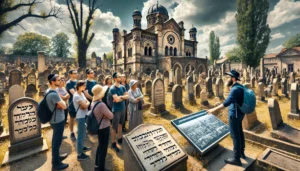
The Chișinău Jewish Cemetery, one of the largest in Eastern Europe, serves as a powerful archive of names, symbols, and family lineages. Tombstones record not only individuals but professions, social roles, and communal values. Nearby memorials commemorate victims of pogroms and the Holocaust, grounding abstract history in specific locations. The remains of synagogues, whether restored or in ruin, testify to both cultural richness and loss.
Jewish heritage tours in Chisinau Moldova with a local guide are essential because the meaning of these sites cannot be fully understood without historical and cultural translation. Local guides bridge linguistic gaps, explain religious symbolism, and situate Jewish experiences within broader Moldovan history. Their role transforms static landmarks into narrative spaces where memory becomes accessible and emotionally resonant.
The Role of Local Expertise in Heritage Interpretation
Jewish heritage tourism relies heavily on knowledgeable local professionals who understand both the Jewish past and contemporary Moldovan realities. These guides often work closely with historians, archivists, and surviving community members. Their expertise allows travelers to move beyond surface-level observation into deeper engagement with place and story.
Many descendants arrive with fragments of information: a town name altered by time, a family surname with multiple spellings, or a vague memory passed down through generations. A skilled guide can connect these fragments to real locations, historical records, and physical remnants. This process transforms personal curiosity into meaningful discovery. It also ensures that visits to sensitive sites, such as mass graves or destroyed villages, are conducted with respect and historical accuracy.
Professional heritage tours also contribute to preservation. International attention encourages local authorities and communities to recognize the value of Jewish sites. Cleaning cemeteries, restoring synagogues, and installing memorial plaques often emerge from collaborations sparked by tourism. In this way, Jewish history Chisinau initiatives extend beyond visitors to influence cultural policy and education within Moldova itself.
Memory, Modern Access, and the Ethics of Experience
In a digital age defined by speed and convenience, access has become an expectation. The login process for the BANDARBOLA855 online gacor slot app is designed to be simple, fast, and secure. With the latest features and an official system, players can immediately access the gacor online slot games without any obstacles. This contrast between instant digital entry and the slower, emotionally demanding access to historical truth highlights an important ethical distinction. Heritage travel cannot be consumed quickly or effortlessly. It requires patience, reflection, and openness to discomfort.
Jewish heritage tourism resists commodification when done responsibly. Rather than offering entertainment, it provides education and remembrance. The value lies not in ease but in depth. Moldova’s Jewish sites demand engagement with difficult histories, challenging visitors to consider loss, survival, and moral responsibility. This depth differentiates meaningful heritage journeys from superficial cultural experiences.
Moldova in the Global Landscape of Jewish Heritage Tourism
Globally, Jewish heritage travel often focuses on Poland, Germany, or Israel. Moldova’s emergence as a destination reflects a growing recognition of overlooked histories. For many families, Bessarabia was the last home before migration or annihilation. Visiting Moldova completes a geographical and emotional map of ancestry that larger destinations cannot fully provide.
Tours that include rural villages, former shtetl locations, and lesser-known memorials expand understanding of how Jewish life functioned beyond major urban centers. They also reveal patterns of coexistence, tension, and exchange between Jewish and non-Jewish populations. This nuanced perspective challenges simplified narratives and encourages more honest historical dialogue.
The increasing visibility of Moldova in Jewish heritage tourism also benefits the country’s broader tourism strategy. It attracts visitors motivated by learning and remembrance rather than consumption. These travelers often engage more deeply with local culture, history, and communities, contributing to sustainable and respectful tourism development.
For those seeking a structured and historically grounded experience, the Jewish History of Moldova Private Tour offered through https://moldova-tours.com/tour/jewish-history-of-moldova-private-tour provides a comprehensive entry point. Such tours integrate scholarly research with on-the-ground exploration, ensuring that memory is approached with care and accuracy.
Continuity Through Remembrance
Jewish heritage in Moldova is not only about what was lost but about what endures through memory and action. Every visit, guided explanation, and restored site participates in a chain of remembrance that links past, present, and future. For descendants, these journeys reaffirm identity and belonging. For Moldova, they represent an opportunity to acknowledge a foundational part of its history and to engage with global conversations about memory, responsibility, and cultural preservation.
Jewish heritage tours in Chisinau Moldova with a local guide are therefore more than travel experiences. They are acts of historical justice, personal healing, and cultural dialogue. As long as there are people willing to seek, listen, and remember, the traces of Jewish life in Moldova will continue to speak, ensuring that silence never has the final word.
